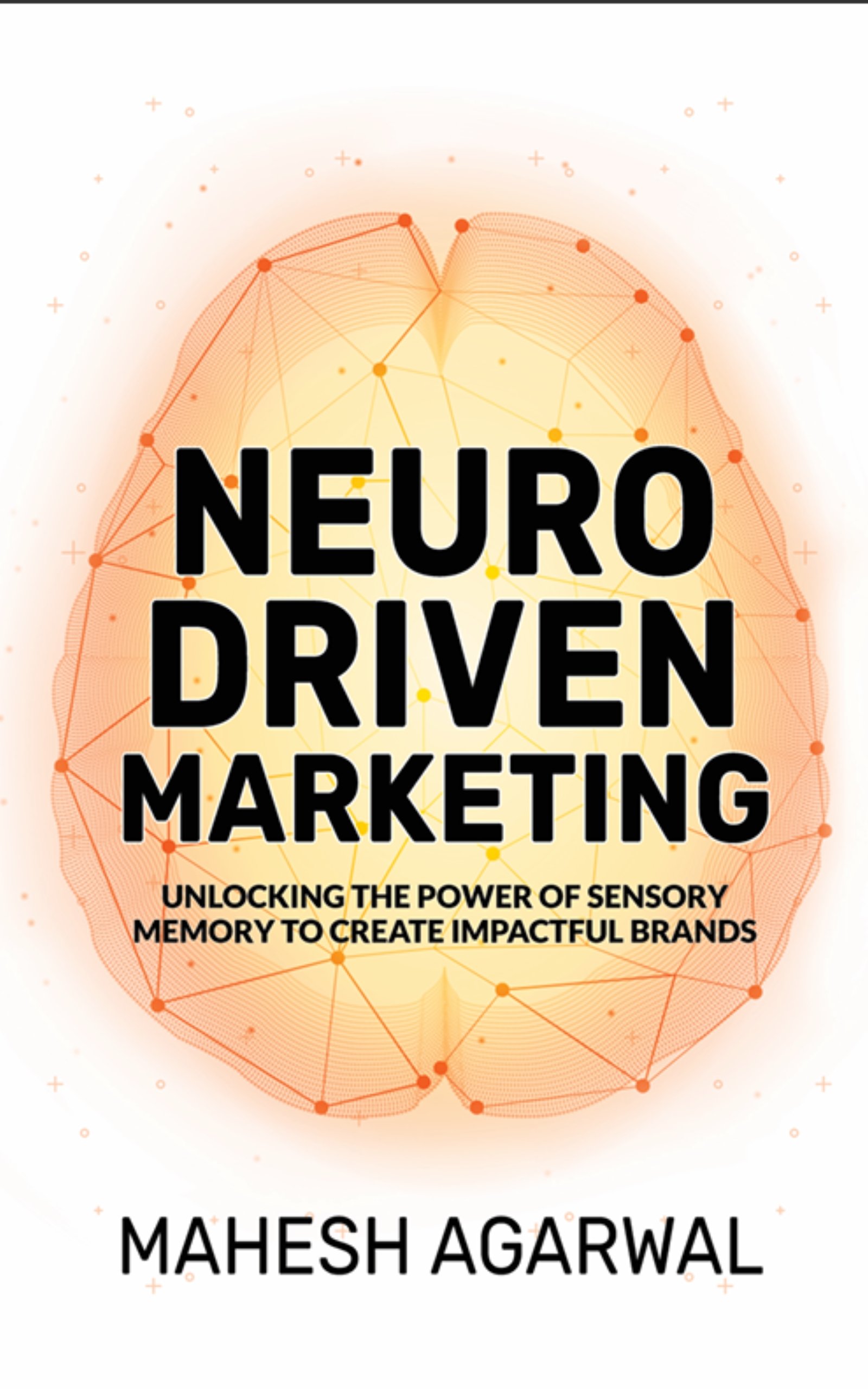
Where to buy
Carried by Amazon in every market, Barnes & Noble, Walmart, Waterstones, Booktopia, Kinokuniya, Flipkart, Google Books, Apple Books and Kobo. Printed on demand close to wherever it is ordered.
Listed with the worldwide trade network, so any bookstore or library can order it. Ask for it by ISBN: 978-1957456805 (paperback) or 1957456809 (hardcover).
What is inside
The answer may lie in how the human brain processes information, forms memories, and makes decisions beyond conscious awareness.
In Neuro-Driven Marketing, Mahesh Agarwal, Co-founder of Neurosensum, explores the relationship between neuroscience and consumer behaviour. Drawing on over 30 years of market research experience, he explains how understanding the brain can help marketers move beyond what consumers say to explore the emotions, instincts, and memories that influence their choices.
The book examines how sight, sound, touch, smell, and taste shape brand perception and create lasting sensory memories. It explores the science behind sonic branding, visual identity, packaging, product experiences, and emotional connections, demonstrating how sensory cues influence consumer decisions.
Readers will discover how neuroscience can be applied across the marketing mix, from product development and pricing to advertising, customer experience, and brand loyalty.
The book also introduces neuroscience-based research methods, including EEG, eye tracking, facial coding, and Implicit Association Testing. It examines how these technologies, alongside artificial intelligence and traditional research, can provide additional insights into consumer responses.
Through practical examples, real-world brand applications, and a sensory brand audit framework, Agarwal connects scientific concepts with everyday marketing challenges.
Neuro-Driven Marketing is written for marketing professionals, brand managers, business leaders, entrepreneurs, market researchers, creative strategists, and customer experience professionals seeking a deeper understanding of consumer behaviour.
Whether developing a new product, refining brand positioning, evaluating advertising, or designing customer experiences, readers will find frameworks for incorporating neuroscience into their marketing decisions.
The book offers a practical perspective on creating brands that consumers do not simply recognise but remember through meaningful sensory experiences.
Excerpt
From “PART 1: Why Neuromarketing?”
You know that feeling when you’ve driven home on autopilot and barely remember the turns? That’s your brain saving energy by falling back on habits. It doesn’t need to figure out the route daily — it has a shortcut.
This idea of mental shortcuts is central to how our brain handles daily life. In psychology, these are called heuristics, i.e., simple rules or patterns that help us make decisions quickly without using too much mental bandwidth.
Now, this may sound lazy, but it’s actually genius. Imagine if your brain had to carefully analyze every email, every menu, every Instagram post, every shopping choice... you’d be exhausted by breakfast.
Heuristics are the brain’s way of saying, “Let me save you the trouble.”
And yes, these shortcuts can sometimes go wrong and lead to biases, but they’re still more efficient than overanalyzing everything.
Another thing to note is that the brain has a limited capacity for conscious thinking. It can only focus on a few things at a time, so it tends to filter out anything that feels irrelevant. That’s why your brain often favors emotions over logic feelings are quicker and demand less effort than deep analysis.
Also, our brain loves familiarity. It leans heavily on past experiences when making decisions.
Even if it’s not the most rational choice, going with what “feels right” is often more energy efficient.
That’s what we call a gut feeling, and it’s often just your brain reaching into its archive of memories.
Now, think about how often we simplify decisions by turning them into binary options yes or no, buy or don’t, like or skip. This is the brain trying to avoid cognitive overload. However, if it has to make too many decisions in a row, it becomes tired. This is what we call decision fatigue—and it’s very real. After a long day, even choosing what to eat can feel like a major task.
This insight into the energy-hungry brain opens up powerful possibilities for marketing.
If you want someone to make a decision, make it easy. Reduce the effort. Remove friction. Offer choices, but not too many. Use familiar and emotionally resonant visuals and words.
If the brain finds something comforting, efficient, or habit-forming, it’ll take to it like fish to water. That’s why things like default settings, emotional storytelling, and consistent brand cues work so well.
And when you understand that even your most “rational” customers are making decisions based on what feels familiar, fast, or emotionally satisfying, you change the entire way you approach communication.
Trailer
About the author

Co-founder and Managing Director, Neurosensum · Jakarta, Indonesia
“It has been a pleasure working with Stardom Books. The team was professional at every step, from editing and publishing to marketing, and patient while I wrote and rewrote my book.”
Mahesh Agarwal, Co-founder and Managing Director of Neurosensum, has 30+ years of research experience. He combines behavioural economics and neuroscience to uncover the subconscious key drivers behind consumer decisions.
Published by Stardom Books — written from the author’s own words, in the author’s name. Browse the catalogue
Start here
The Authority Quotient is a thirty-minute evaluation that measures your authority two ways — how you rate yourself, and what a stranger can verify — and ends with one specific recommendation, including which type of book is yours.
Find your Authority QuotientNo cost. Get detailed report. Includes specific recommendations.