Where to buy
Carried by Amazon in every market, Barnes & Noble, Walmart, Waterstones, Booktopia, Kinokuniya, Flipkart, Google Books, Apple Books and Kobo. Printed on demand close to wherever it is ordered.
Listed with the worldwide trade network, so any bookstore or library can order it. Ask for it by ISBN: 978-1957456348 (paperback) or 978-1957456386 (hardcover).
What is inside
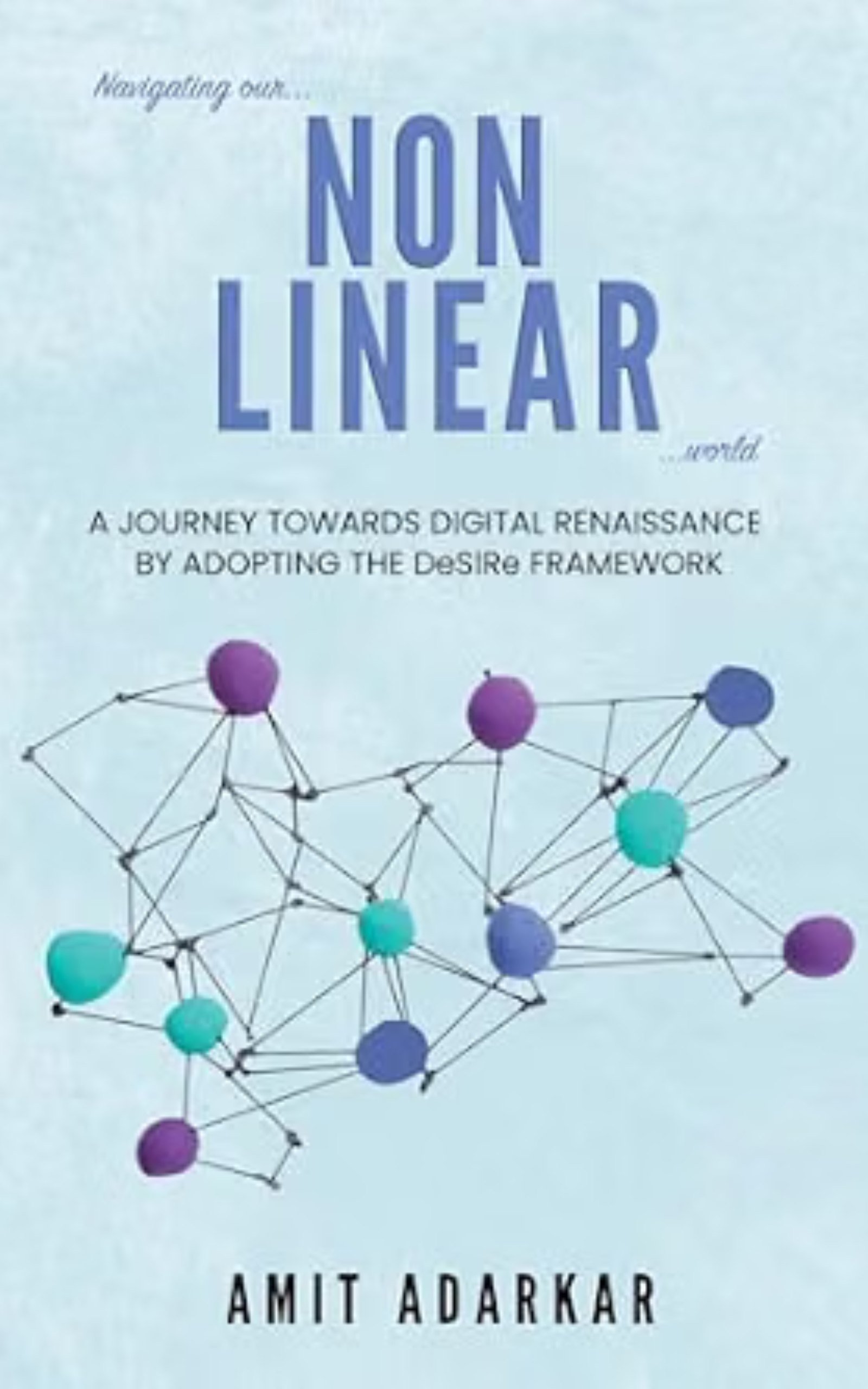
How can we understand an increasingly nonlinear world and prepare ourselves for the opportunities and challenges of the Digital Renaissance?
Technology is transforming the way we live, work, communicate, and make decisions. As digital systems become more interconnected and artificial intelligence advances, the relationship between cause and effect is becoming increasingly complex and unpredictable.
In Navigating Our Nonlinear World, Amit Adarkar explores how technological evolution is reshaping society and influencing human thinking and behaviour.
Drawing on three decades of experience in market research and his curiosity about human behaviour, Amit examines how technology has evolved, how its role has changed, and why today's digital environment is creating a more nonlinear world.
The book explores the growing influence of generative artificial intelligence and how its development could accelerate technological and societal change.
Readers will discover how nonlinear systems affect everyday experiences, decision-making, and our ability to anticipate future outcomes. The book also examines the opportunities and risks associated with living in a world where change is increasingly interconnected.
Looking beyond the present, Amit draws parallels with the Classical Renaissance of the 15th century to explore the possibility of a new Digital Renaissance.
At the heart of the book is the DeSIRe framework, which offers readers a structured approach to navigating nonlinearity and making the most of emerging opportunities.
Rather than viewing technological disruption solely as a threat, the book encourages readers to understand its complexities and approach change with greater awareness.
Who is this book for?
Navigating Our Nonlinear World is written for working professionals, mid-level managers, senior leaders, and individuals seeking to understand the changing relationship between technology and society.
It is particularly relevant to readers curious about artificial intelligence, digital transformation, and the benefits and adverse effects of technological advancement.
The book offers perspectives for understanding nonlinear change and preparing for a future shaped by the Digital Renaissance.
Excerpt
From “1 The Nonlinear World”
Chapter 1: The Nonlinear World
"The universe is so much bigger than you realize."
Alpha Waymond, Everything Everywhere All at Once
As you may know, the Oscar-winning movie Everything Everywhere All at Once is based on the idea of the 'multiverse', which entails the coexistence of unique multiple universes simultaneously and that each unique universe comprises 'reality' in that world. The multiverse concept has been explored across several comics, TV shows, and movies. The animated series Rick and Morty had its main characters communicate with different versions of themselves across the multiverse. Marvel Cinematic Universe has recently unlocked the gateway to box office success by popularizing the multiverse. Interestingly, the ideas about alternate realities are ancient and varied. In 1848, the author Edgar Allan Poe wrote a prose poem in which he fancied the existence of "A limitless succession of Universes."
This book is not scholarly, scientific, or even a pop culture discourse on the multiverse. However, the multiverse concept offers a few pointers to our current world. We live in parallel coexisting realities in today's complex and physical world. There are moments we spend time in the physical world attending office or college in person, and there are other moments when we go virtual or digital while working or attending classes remotely. We are used to digital identities or avatars, and at the same time, we are equally comfortable in our own 100% natural skin. We use good old paper money and deal in digital money or cryptocurrency. Afterlife Apps allow us to live after we are dead.
We make friends and unfriend people in the physical and digital worlds.
The third epoch of technology adoption led to this multiverse-like complexity. Technology is embedded in everything we use and function with daily. In all honesty, we cannot survive in this day and age without physical or digital technology. Let's examine the Internet of Things (IoT), which seamlessly links physical and digital technology. IoT refers to physical objects with sensors, processing ability, software, and other technologies that connect and exchange data with similar connective devices and systems over the Internet or other networks with connections. The idea of the Internet of Things first appeared in a speech by Peter T. Lewis. According to Lewis, "The Internet of Things, or IoT, is the integration of people, processes, and technology with connectable devices and sensors to enable remote monitoring, status, manipulation and evaluation of trends of such devices."
Trailer
About the author

CEO, i.Genie.ai · Mumbai, India
“As a first-time author, I had a good experience with Stardom Books at every stage. The team kept me motivated, and their guidance and support helped me complete my first book.”
Amit Adarkar is a market researcher with 30 years of experience studying human behaviour. An optimist and avid blogger, he explores how technology unlocks human potential and connects data with everyday life.
Published by Stardom Books — written from the author’s own words, in the author’s name. Browse the catalogue
Start here
The Authority Quotient is a thirty-minute evaluation that measures your authority two ways — how you rate yourself, and what a stranger can verify — and ends with one specific recommendation, including which type of book is yours.
Find your Authority QuotientNo cost. Get detailed report. Includes specific recommendations.